International collaborations
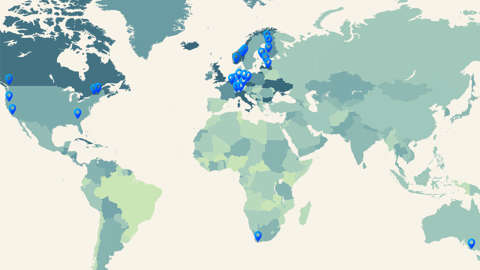
Skogforsk is actively engaged in international projects, partnerships, and research programmes. These collaborations strengthen knowledge exchange, broaden research foundations, and link Swedish forest research to European and global strategies for sustainable forestry.
Within the framework of our current Research & Innovation strategy, we intend to increase our involvement in international projects and collaborations. Together with broader environmental analysis, these partnerships ensure that Skogforsk’s operations meet high international standards and that important results reach the global arena.
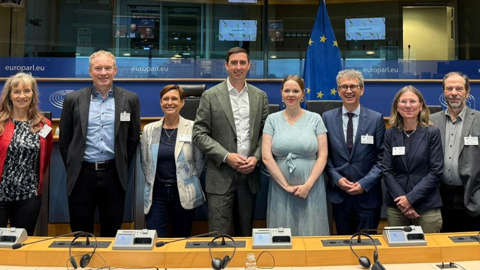
In Europe, Skogforsk contributes both to joint policy documents and research collaborations that highlight the role of forests in climate policy, as well as to showcasing the multiple benefits of forests — an area that requires difficult trade-offs in a growing bioeconomy.
Globally, Skogforsk is deepening its cooperation with international research actors to develop future forest technology, digitalisation, and value chains. Through researcher exchanges, joint projects, and international conferences, Swedish forest research and new innovations are shared with a global audience.
Taken together, these international efforts advance knowledge on sustainable forestry and position Skogforsk as an important international partner in the transition to a bio‑based society.
At present, we are involved in approximately 25 collaborations.
Selection of Collaborations
ForForest+
A collaboration between forest research institutes in Austria, Finland, Slovenia, Sweden, Italy, and Latvia. ForForest+ aims to develop and strengthen cooperation on forest‑related issues, share information on best practices, and seek common positions on forest policy matters, in line with sustainable forestry.The Forest-based Sector Technology Platform (FTP)
The European hub for research and innovation within the forest‑based bioeconomy. Its goals are to enhance the competitiveness and sustainability of the European forest‑based sector through research, innovation, and cooperation between industry, forest owners, and public actors. FTP develops and drives a joint strategic research and innovation agenda for the sector.http://www.forestplatform.org
Profor
PROFOR is a Nordic–Baltic research network that promotes sustainable forestry in a growing European bioeconomy. It compiles and communicates regional forest research in support of EU policy work, particularly related to the EU Green Deal. The network focuses on balancing carbon sequestration, timber production, and biodiversity in European forestry.https://nordicforestresearch.org/n2020-05/
Forest Innovation Summit
An international conference connecting the Swedish and Californian forest sectors to promote innovation, knowledge exchange, and collaboration on sustainable forestry. The goal is to foster dialogue and solutions to global forest challenges such as climate change, increasing wildfires, and the need for new technologies and policies. The conference acts as a platform for experts, policymakers, researchers, start‑ups, and investors to share ideas, present innovations, and build partnerships for the future of forestry.https://www.forestinnovationsummit.com/
Stanford
StanForD is an internationally used standard for data and communication between forest machines, developed to enable efficient information transfer throughout the forest industry’s production chain. Skogforsk is responsible for developing and managing the standard, which is now used globally by leading machine manufacturers and forest companies. The work is driven through recurring industry meetings where new needs are discussed and decisions on further development are made.https://www.skogforsk.se/stanford/
Plantval and Plantval Optimal
Tools that provide forest owners and seedling producers with improved decision support for selecting climate‑adapted and productive forest reproductive material for regeneration. The goal is to develop shared models and decision support tools for forest reproductive material across the Fennoscandian region. Collaborative work around the tools and their underlying models has been ongoing for many years with researchers and stakeholders in Sweden, Norway, and Finland. Previously through major EU projects such as Noveltree and B4EST, and currently (2025–2027) within an SNS project: “Assisted migration in practice for climate‑adapted and resilient Nordic forests”.Northern Traffic Light
An EU project where researchers from Sweden and Finland collaborate to develop a digital system providing real‑time information on road conditions in northern Scandinavia. The goal is to secure more resilient access to forestry operations and natural resources to support the transition to a green and sustainable rural economy in a changing climate.https://www.luke.fi/en/projects/northern-traffic-lights
Nordic Testbed Network
The Nordic Testbed Network is a Nordic–Baltic collaboration that accelerates digitalisation within agriculture, forestry, and fisheries. By linking together testbeds, it enables knowledge exchange and joint development of new technological solutions. The aim is to strengthen the competitiveness of the bioeconomy and create more sustainable and efficient resource use in the region. Skogforsk contributes through its collaboration with Ouluzone+ via the Troëdsson Forestry Teleoperation Lab.https://nordictestbednetwork.se/