




david.fridner@skogforsk.se
+46 (73) 058 26 80

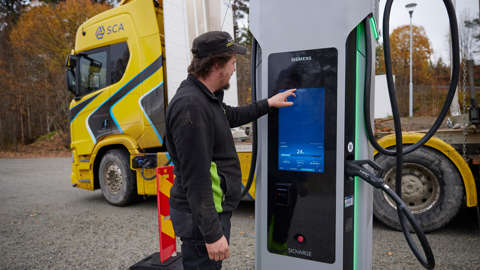
This article is a summary of results from the studies "Decision factors and trade-offs in BET adoption: insights from Swedish forestry freight haulers" (Shenoy et al)., "Electrifying Heavy Transport: Haulage Owners’ Evaluative Dimensions and the Conditions for Workability" (Fridner et al.) and "Hur resonerar åkerier kring ellastbilar?" (Bygge et al.) For more information on the TREE project, visit: TREE project page
The electrification of heavy trucks is central to the sustainability ambitions of both the forestry and transport sectors. This transition will largely be determined by the haulage companies that must invest in the vehicles. Their day-to-day operations must still function under new conditions regarding charging, employed capital, and the work environment. In three separate studies, the TREE project has focused specifically on the perspective of haulage companies: what conditions need to be satisfied and what are the current obstacles to the transition?
The studies show which critical pieces of the puzzle need to be in place for electrification to be seen as a reasonable choice for a company's business operation: productivity must be maintained, charging must be integrated into the working day, and there must be commercial buy-in from customers. The results suggest that haulage companies are not necessarily sceptical about electrification. On the contrary, there is clear curiosity and positive experiences among those that have tested electric trucks. At the same time, haulage companies are pragmatic: the big question is not the technology itself, but how it affects day-to-day operations.
Study 1 (Bygge et al., 2025) is based on interviews with decision-makers in timber and woodchip haulage companies, as well as with drivers already operating electric trucks in forestry operations. It shows how haulage companies assess electric operation in their own day-to-day work, where technology, planning, investment, and the work environment must come together at the same time. A central finding is that positive experiences of the driving itself can coexist with considerable doubt about whether electric operations can be made to work in the company's business operation. The study also shows that more predictable logistical flows, such as chip trucks between industries, are more clearly seen as possible first steps than roundwood transports.
Study 2 (Shenoy et al., 2026) takes a systems perspective. It shows that decisions about electric operation cannot be understood by looking at cost, charging or technology in isolation. Instead, charging availability, battery size, payload, productivity and profitability influence one another in a larger system of trade-offs. Electrification therefore emerges as a systems challenge rather than a series of separate problems. One interesting point is that the study highlights driver anxiety related to charging and operational stress as an important factor in the transition – something that has rarely been emphasized before.
Study 3 (Fridner et al., 2026) focuses on how haulage company owners assess the possibility of electrification in practice. It shows that owners' reasoning is broad and multidimensional, revolving around no fewer than eight recurring dimensions: economy, charging, flows, technology, drivers, service (including safety issues), sustainability, and policy. Economy and charging clearly weigh most heavily in owners' reasoning, while sustainability and policy play much smaller roles. The study also shows that, in practice, electrification is tested in two intertwined ways: whether everyday productivity can be preserved, and whether the investment can be made commercially viable together with the customer.
Individually, the studies illuminate different parts of the same transition, but together, they provide a more comprehensive picture. The first shows the issues in day-to-day operations. The second demonstrates how different factors connect and reinforce or retard each other over time. The third shows what owners consider when deciding whether electric operation can be made to work in their business operation. Overall, the picture shifts the focus from the binary question of whether haulage companies are positive or negative to what needs to be in place for them to say yes.
What all three studies have in common is that electrification is not assessed as an isolated technology issue. The key question is whether the business can still be run in a reasonable way. Three conditions recur:
Taken together, the three studies paint a picture in which electrification is attracting curiosity among haulage companies but is simultaneously weighed against an already pressured day-to-day reality with little room for mistakes and additional risk. What determines the outcome is less the technology itself than how well the overall set-up works in practice. This makes electrification a shared transition challenge rather than something that haulage companies can shoulder on their own.