
jon.ahlinder@skogforsk.se
+46 (72) 961 66 53

A study by Skogforsk and the University of Oulu shows that tree breeders can make their selection of parent trees considerably more robust by taking into account how uncertain each breeding value is. In two Norway spruce progeny trials, the new method raised the genetic gain in the least favourable outcomes by 6.6 per cent, while the expected genetic gain fell by only 0.7 per cent (Figure 1). At the same time, the number of selected trees increased from 145 to 159, which broadens the genetic base of the selected cohort.
Genetic gain is measured on a combined index of tree height, height growth and number of ramicorns, and the percentages are relative changes compared with conventional selection, and not percentages of tree height.
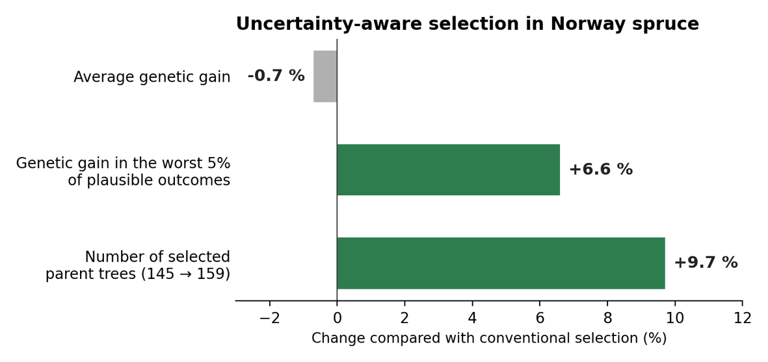
Figure 1. Uncertainty-aware selection (CVaR-OCS) compared with conventional selection in 1,218 genotyped Norway spruce trees. A small loss in average gain buys clearly better protection against unfavourable outcomes and a broader selection. Source: Ahlinder & Waldmann 2026, Genetics.
When breeders choose which trees should become parents of the next generation, or contribute to a seed orchard, they use breeding values estimated from field trials. The tool used to make the choice (optimum contribution selection) balances genetic gain against relatedness, so that progress is made without building up inbreeding. Until now, however, the tool has treated each breeding value as if it were known exactly.
In reality, the estimates are uncertain, and the uncertainty is greatest among siblings. Trees in the same family share the same parents, and field data can only partly reveal which sibling inherited the best genes. In the analyzed spruce material, the top-ranked tree in a high-performing family had only a 48 per cent probability of truly belonging to the best tenth of its family (Figure 2). Because a strict limit on relatedness forces the selection to pick the best individuals within families, it is exactly these uncertain rankings that matter most.
This leads to what is known as the winner's curse. When the trees with the highest estimated breeding values are picked, the selection will inevitably include some trees that look good partly by chance: their breeding values have been overestimated, and the genetic gain realised in the next generation becomes lower than expected. In simulated data, where the true breeding values were known, conventional selection achieved only 78 per cent of the genetic gain that would have been possible with perfect knowledge of the true values.
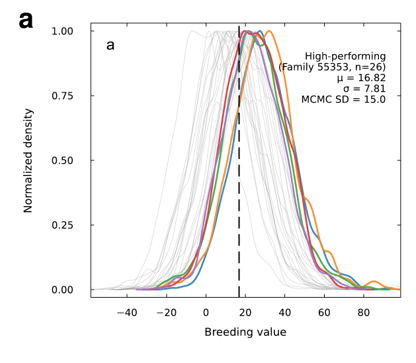
Figure 2. Plausible breeding values for the 26 trees in one high-performing Norway spruce family. Each curve shows the range of plausible values for one tree, and the coloured curves are the five top-ranked trees. The curves overlap almost completely, so which sibling is truly best is far from certain. Dashed line = family mean. Source: Ahlinder & Waldmann 2026, Genetics, Fig. 2a (CC BY 4.0).
To see how much this affects the decision, the researchers repeated the selection 5,000 times, each time using a different but equally plausible set of breeding values. The result varied considerably: not a single tree was chosen in more than about a third of the runs. Trees with high breeding values were still favoured, but which particular trees ended up in the selection was far from certain.
The new method, called CVaR-OCS, borrows a risk measure that banks and investors use to protect a portfolio against the worst outcomes (Conditional Value at Risk). A breeding population can be seen as a portfolio of trees: instead of betting heavily on a few trees whose high values may be overestimated, the trees most exposed to the winner's curse, the method spreads the contributions so that the outcome remains good even when the breeding values fall at the unfavourable end of what is plausible. All 5,000 scenarios are handled in a single calculation, which for one of the case studies (spruce field trial data) took about a minute and a half.
The study also shows that the intuitive shortcut does not work. Simply removing the 40 selected trees with the most unstable rankings cost 4.4 per cent of the genetic gain in index EBV compared to without incorporate uncertainty, which is six times more than the new method, and actually made the worst-case outcome 3.7 per cent poorer. With fewer trees to choose from, the contributions were concentrated on an even smaller group of top-ranked trees, which made the selection more fragile in the long term, not less.
The Norway spruce data come from two progeny trials established by Skogforsk in 1988 to evaluate the parent trees of the Hissjö seed orchard: one near Vindeln in Västerbotten (S23F8820476) and one at Hädanberg in Västernorrland (S23F8820477). In total, about 5,500 offspring from 142 families and 72 parents were planted as single-tree plots, which spreads each family over the whole trial area. The trees were measured at ages 7 and 17. The selection index gave equal weight to tree height and height growth at age 17, and counted the number of ramicorns (spike knots) negatively. By age 17, about 81 per cent of the trees were still alive. A total of 1,218 trees from 126 families, distributed over both trials, were genotyped with about 300,000 DNA markers.
In addition, the method was also tested on simulated data, where the true breeding values are known, and on a loblolly pine breeding population in the USA, with consistent results. The study was funded by Föreningen Skogsträdsförädling.
The results show that uncertainty-aware selection can make breeding populations and seed orchards less vulnerable to errors in breeding values, while keeping almost all the expected genetic gain and broadening the genetic base. The method can be used wherever breeding values are estimated with Bayesian methods, and the code and the spruce data are openly available. Before implementation, the development over several breeding generations, in terms of both genetic gain and inbreeding, needs to be studied in long-term simulations.