

ulf.sikstrom@skogforsk.se
+46 (70) 638 85 52

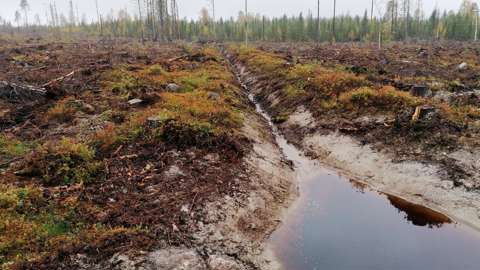
Over the past 120 years, drainage of wetlands in Swedish forest areas has contributed to increased forest production but also caused profound changes in the forests’ turnover and storage of water. Over time, sediment and vegetation accumulate in the ditches, and ditch cleaning may be needed to maintain high forest production. However, the measure can, among other things, affect the quality of runoff water. It is known that erosion of soil particles increases. This can lead to increased transport of suspended particles (eroded resuspended soil particles), and particle-bound nitrogen and phosphorus, from the ditch system, which in turn may affect downstream waters.
The purpose of the study was to investigate whether there are differences in concentrations of various water quality variables and dissolved greenhouse gases between ditch water from cleaned and uncleaned ditches, with particular focus on mercury. Increased levels of mercury and bioavailable methylmercury have been pointed out as potential risks during ditch cleaning, but few studies exist. In this study, we tested the hypotheses that the total concentration of mercury and the concentration of methylmercury in ditch water increase due to ditch cleaning.
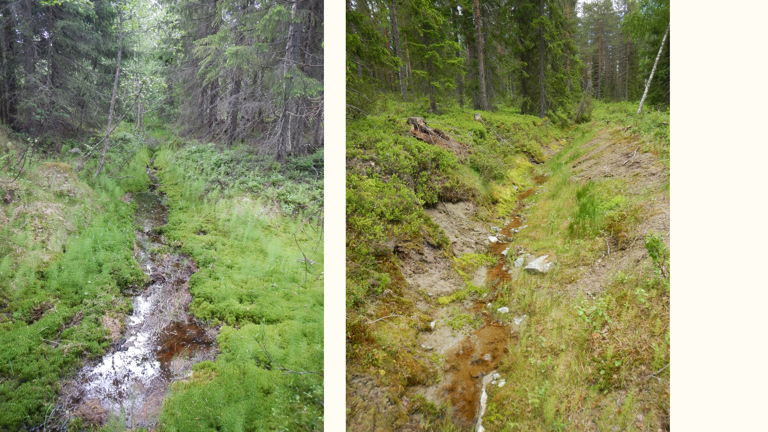 Figure 1. One of the investigated 13 ditch pairs in mature forest, uncleaned ditch to the left and cleaned to the right. Photos: Joel Segerstedt
The results from the study showed that the total concentration of mercury and the concentration of methylmercury in runoff ditch water were not higher in cleaned than in uncleaned ditches. The ditch cleanings had been carried out one to four years before the samplings. The study included 25 ditch pairs with cleaned and uncleaned ditches located along the Norrland coast and in northern Uppland. The concentration of methylmercury was lower in cleaned than in uncleaned ditches if they were located in forested areas (-17%, 13 pairs), but not in ditches in clear-cut areas (12 pairs).
Other substances, absorbance, and greenhouse gases were also measured in the ditch water, a total of 20 variables in addition to mercury. The differences that could be demonstrated, when all ditch pairs were included in the analysis, were higher pH (+0.6 units), sulfate (+96%) and calcium concentration (+35%) in cleaned ditches, as well as lower concentration of carbon dioxide dissolved in the water phase (-40%). In addition, the concentration of nitrous oxide was about three times higher in cleaned ditches compared to uncleaned.
One purpose of the Environmental Protection Agency project was to highlight the trade-off in the title. The idea was to identify areas that are more or less advantageous to ditch clean from these two perspectives. The project also included a literature review on the effects of ditch cleaning on tree growth. But, since no increased concentrations of mercury could be demonstrated, the question of the trade-off fell. The literature review is included in the Swedish final report, Effekter av dikesrensning och våtmarksrestaurering på kvicksilver i vatten (naturvardsverket.se)
The sampled ditches are located in the eastern part of central Sweden, from Uppland to Västerbotten. With the help of GIS data from forest owners, a large number of ditches “in the landscape” were identified that had been cleaned 1–4 years before the first sampling of ditch water was carried out. The final selection of the 25 cleaned ditches to be sampled was made in the field, with the requirement that they were located on forest land. Then, an uncleaned reference ditch was identified near each cleaned ditch, but the two ditches were to be hydrologically disconnected. The result was an average distance of about 2 km between the ditches in the ditch pairs. The criteria for the references were that they should not show any signs of having been recently cleaned, lie close to the cleaned one, and otherwise be as similar as possible to the cleaned ditch. This also applied to the catchment area drained by the ditch system in terms of size, tree vegetation, and wetland cover. In the end, 25 pairs were sampled; 25 cleaned ditches (“Cleaned ditches”) and 25 not recently cleaned ditches (“Uncleaned ditches”).
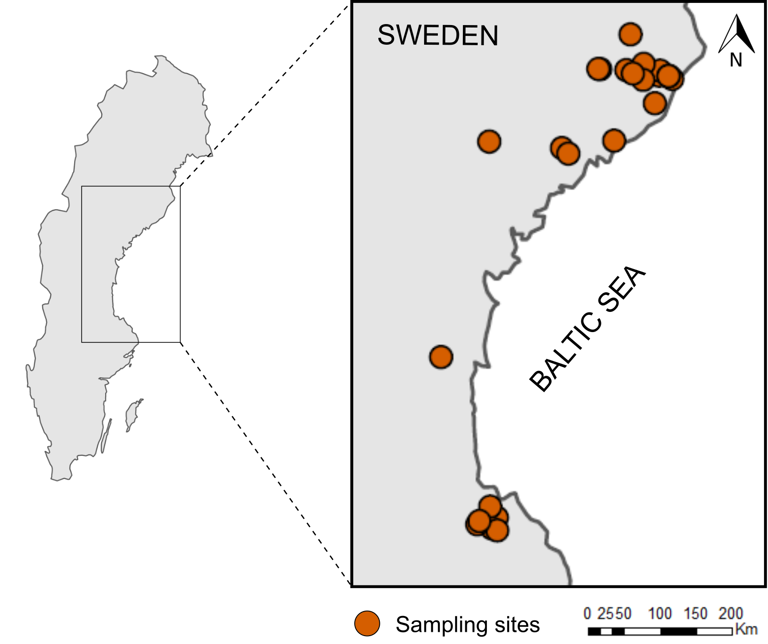
Figure 2. Location of the cleaned ditches included in the study. The map shows only the cleaned ditches.
The study also included examining whether possible differences between cleaned and uncleaned were affected by whether the ditches were in mature forest or in clear-cut areas. Therefore, 13 of the ditch pairs were located in forest areas and 12 pairs in clear-cut areas.
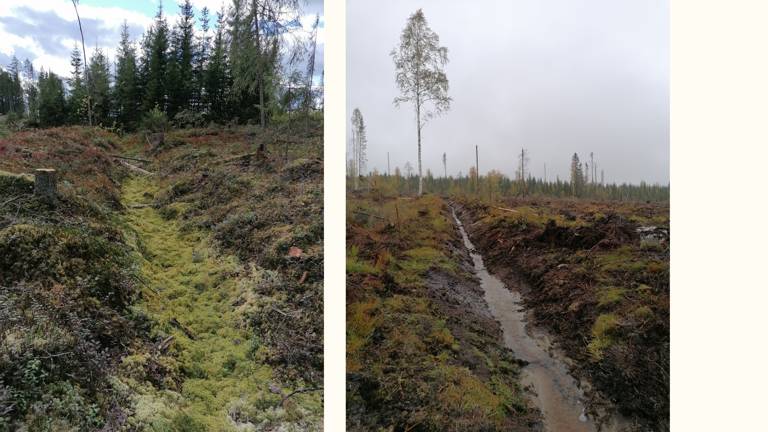 Figure 3. One of the investigated 12 ditch pairs in clear-cut areas, uncleaned ditch to the left and cleaned to the right. Photos: Alberto Zanella, SLU
The catchments with the 25 cleaned ditches have an average area of 37 hectares (2–136 hectares) and the 25 reference areas 44 hectares (5–176 hectares). The areas are typical for the region and are dominated by coniferous forest, on average 92% for cleaned ditches and 89% for reference areas. Moraine soils dominate, 63% and 58% respectively. The average peat depth is 23 cm (12–44 cm) and 26 cm (12–51 cm) respectively. The annual precipitation in all areas varies between 630 mm and 840 mm and the annual mean temperature from 2 to 6 °C.
Water samples were collected from the 50 ditches at three samplings. The first in June 2021, the second in September 2021, and the third in June 2022. The samples were analyzed for the total concentration of mercury and the concentration of methylmercury, 15 other water chemistry variables, and two optical variables (absorbance). Samples from one or two samplings were also analyzed for greenhouse gases dissolved in the water, namely methane (sampling 2 and 3), nitrous oxide (sampling 2), and carbon dioxide (sampling 3). Analyzed substances and analysis methods are described in the attached publications.
To evaluate the effect of ditch cleaning, the difference (Δ) in water chemistry concentrations between the cleaned and uncleaned ditch was first calculated for each ditch pair and sampling occasion. Then it was tested whether the Δ values differed significantly from zero in a statistical analysis. The statistical analyses were carried out for all 25 ditch pairs and separately for the ditch pairs located in forest (13 pairs) and in clear-cut areas (12 pairs).
In our spatial study, the concentration of methylmercury was lower in ditch water in cleaned ditches than in uncleaned for the ditch pairs located in forested areas (13 pairs). This did not apply to the 12 ditch pairs in clear-cut areas, where the concentration did not differ significantly. For the total concentration of mercury, there was no difference between cleaned and uncleaned.
These results, that mercury concentrations were not higher in cleaned ditches, were supported by the result from an experimental study in Trollberget near Vindeln in Västerbotten. There, ditch cleaning of ditches in a clear-cut area was studied. In that study as well, mercury concentrations in ditch water did not increase after cleaning; instead, the concentrations of both forms of mercury were lower during the two years investigated after the cleaning (Effects of Ditch Cleaning and Wetland Restoration on Mercury in Water, naturvardsverket.se).
However, in another Swedish study, higher total concentrations of both methylmercury were reported during a few days directly after cleaning at one of the two experimental sites included in the study, DiVa - Dikesrensningens effekter på vattenföring, vattenkemi och bottenfauna i skogsekosystem (diva-portal.org).
In the spatial study, a lower concentration of dissolved carbon dioxide and a higher concentration of dissolved nitrous oxide in ditch water from cleaned ditches were demonstrated when all ditch pairs were included in the analysis. Lower concentration of carbon dioxide was also demonstrated for the ditch pairs in forest. These changes are significant for greenhouse gas balances at the landscape level.
It is known that ditches and watercourses in boreal forest can release the greenhouse gases carbon dioxide, methane, and nitrous oxide from the water to the atmosphere. This can be significant shares of the emissions for complete greenhouse gas budgets at the landscape level. But knowledge about how ditch cleaning affects both the production and the emission of these greenhouse gases is scarce. One study reports unchanged emission of carbon dioxide and methane, while another reports increased methane emission in ditches where moss in the ditch had been removed. This shows the difficulty of generalizing the effect of ditch cleaning on the emission of these two greenhouse gases. Higher concentrations of dissolved nitrous oxide in cleaned ditches may possibly be related to altered oxygen conditions in the soil when the groundwater level is lowered, which in turn affects different parts of the nitrogen cycle including available substrate for production of nitrous oxide.
Probable explanations for the demonstrable differences in substance concentrations in ditch water after ditch cleaning are that when the groundwater level is lowered, due to the measure, the soil water passes through deeper, more mineral soil-rich soil layers. Redox conditions in the soil may also be affected by a lower groundwater level, which in turn affects different chemical reactions in soil and water. The removal of organic material from the ditches themselves may also contribute to reduced risk of formation of methylmercury and carbon dioxide.
The results from the study show that ditch cleaning affects both water chemistry and concentrations of dissolved greenhouse gases in runoff ditch water. Increased pH of similar magnitude has been demonstrated in other studies, as well as increased concentrations of calcium and sulfate. Previous studies have reported decreased concentration of total or dissolved organic carbon, which we did not observe in this study. These effects, although not clearly desirable, cannot be considered clearly negative. That the measure did not increase concentrations of mercury, and did not align with the stated hypothesis of a risk for increase, can be seen as positive. Decreased concentration of carbon dioxide in ditch water may lead to reduced emission to the atmosphere, while the opposite may apply for nitrous oxide, a considerably more potent greenhouse gas.
Considering the effects reported above, it is generally a delicate task to weigh advantages and disadvantages when deciding on possible ditch cleaning with regard to growth, water quality, greenhouse gas balance at the landscape level, and also biodiversity. This study should be seen as a piece of the puzzle in building knowledge about how ditch cleaning affects runoff water.