madeleine.silverbratt@skogforsk.se
+46 (72) 578 88 04

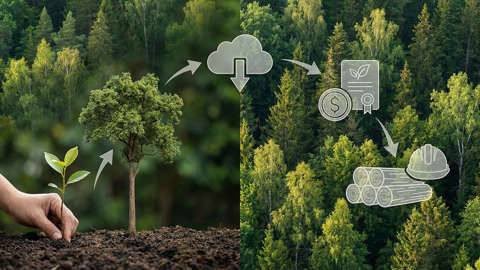
Today, biodiversity lacks market value, despite increasing demands from Sweden's environmental goals and the EU's Nature Restoration Regulation.
The project aims to contribute to a credible and scalable market for biocredits that provide forest owners and companies with new business opportunities, incentives to preserve and restore ecosystems, and contribute to a sustainable transition. These challenges are addressed by developing market-driven, scientifically based, and sustainable business models for biocredits that integrate biodiversity values into forestry. Through current situation analysis, identification of barriers and opportunities, and learning from international experiences, business models are created that target buyers and forest stakeholders.
The work is based on standards such as The Global Biocredit Standard and the framework from the Biodiversity Credit Alliance (BCA). Expected results are effective business models for biocredits as well as increased knowledge and acceptance among society, landowners, and companies. Clear policy linkages that strengthen investments in restoration and conservation will be integrated. Simulations of Vinnova’s future scenarios in combination with biocredits enable evaluation of the robustness of the business model and its effects on biodiversity, climate, and economy.
The project is led by Skogforsk in collaboration with the Royal Institute of Technology (KTH) and the World Forest Forum (WFF). The project also involves a large number of actors from the sales and purchase sides, authorities and international representatives. By combining scientifically based methods, technological solutions, and strong collaboration between stakeholders, the project addresses the structural barriers and lack of policy recommendations that currently hinder the development of a biocredit market. This creates conditions for a sustainable transition and a credible market that can contribute to achieving both national and international biodiversity goals.
The project will be permeated by the systems perspective, where barriers and opportunities will be analyzed based on the 5 system levels:
Infrastructure and production systems: Can biocredits be integrated into today's infrastructure and production systems, or are new solutions required?
Laws and regulations: Are there regulations, requirements or guidelines that facilitate or hinder biocredits? How could the policy landscape change to develop biocredits?